TL;DR / Key Takeaways
- A false decline is a legitimate transaction blocked by a fraud filter or an issuer rule. Real customers, real money, lost sales.
- Industry estimates put global losses from false declines at roughly $443 billion a year, more than merchants lose to actual payment fraud.
- 62% of online merchants say their false decline rate has climbed over the past two years.
- Healthy card-not-present acceptance sits between 85% and 92%, with cross-border traffic 5 to 15 points lower.
- The fixes are unglamorous: tune fraud rules, add routing and retry logic, and apply 3D Secure selectively.
Why False Declines Deserve More Attention Than Fraud Itself?
You track your chargeback ratio. You track your fraud losses. But there is a good chance nobody on your team can tell you what your false decline rate is, and that number may cost you more than fraud ever has.
False declines are legitimate purchases that your own payment stack rejects. Industry estimates put the global cost at roughly $443 billion a year, comfortably more than merchants lose to real fraud. And the trend is going the wrong way: 62% of online merchants report that their false decline rates have risen over the past two years.
This guide covers what a false decline is, how to tell whether you have a problem, and what to change this quarter.
What Are False Declines?
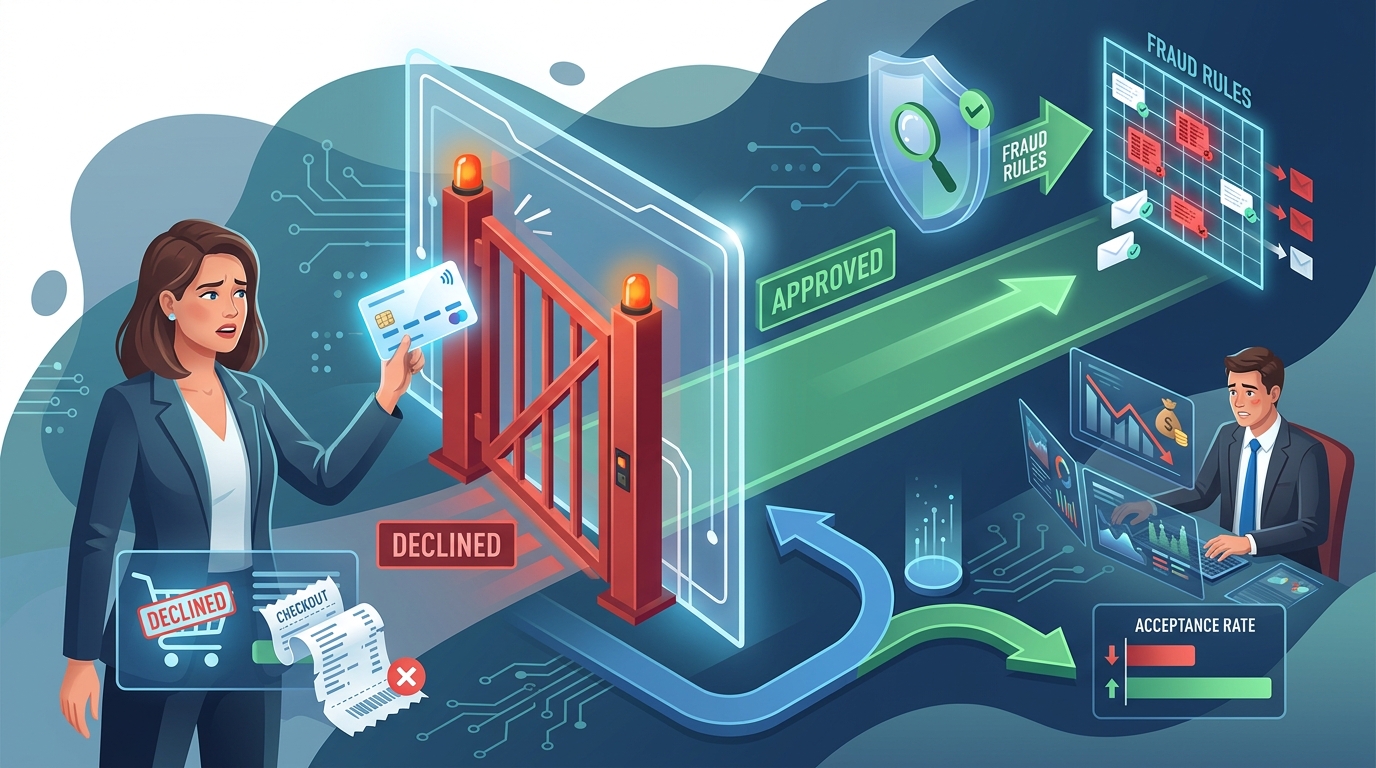
A false decline, also called a false positive, is a legitimate transaction that gets rejected by a fraud filter, a risk rule, or an issuing bank. The buyer had funds and honest intent. The system said no anyway.
The damage is bigger than one lost order. Most shoppers do not retry after a decline. They buy from a competitor instead, and a share never come back, turning one blocked transaction into lost lifetime value.
False declines are also easy to miss. A decline looks like prudence on a fraud dashboard. Nobody complains about a purchase they abandoned, so the loss never appears as a line item.
How Do You Know If You Have a False Decline Problem?
Start with your payment acceptance rate, the percentage of attempted transactions that complete successfully. For a well-configured North American setup, domestic online acceptance typically runs 92% to 95%. General card-not-present ecommerce sits closer to 85% to 92%, and cross-border card traffic usually lands 5 to 15 percentage points below domestic benchmarks.
Then separate two numbers that often get used interchangeably. Authorization rate measures issuer approvals only. Acceptance rate layers your own fraud filters and capture logic on top of that. If your authorization rate drops, the issue sits on the issuer side. If there is a wide gap between the two, the problem is your own risk configuration.
Finally, segment by geography, card type, payment method, and device. False declines cluster rather than spreading evenly, so an aggregate number hides the pattern you need to see.
What Causes False Declines?
Most false declines trace back to four causes.
- Over-aggressive fraud rules. Static rules built on domestic patterns flag anything unfamiliar: a first-time buyer, a large opening order, a mismatched shipping address.
- Issuer-side risk models. Banks apply stricter filters to cross-border and card-not-present traffic, and their decline codes are too vague to diagnose without help from your processor.
- Blanket 3D Secure. Step-up authentication on every transaction adds friction, and mobile shoppers abandon checkout when a redirect stalls.
- Single-route processing. One acquirer means one point of failure, and when that path degrades the customer sees a decline screen.
One caveat: not every decline is false. Roughly 44% of online declines come down to insufficient funds, which is a payment-method-mix question rather than a tuning problem.
How to Reduce False Declines Without Inviting Fraud?
Four moves do most of the work.
- Tune fraud rules to your business, not a generic template. Digital goods, travel, and subscription merchants all have normal buying patterns that look suspicious under default logic.
- Move from static rules to behavioral risk scoring. Systems weighing device fingerprint, transaction velocity, and historical approval patterns separate real buyers from fraudsters far more precisely than fixed rules.
- Add smart routing and retry logic. Dynamic routing raises approval rates by 10% to 15% on average and can recover up to 10% of falsely declined payments. Merchants running more than one acquirer relationship do better too: 85% report improved conversion, and 23% report gains above 10%.
- Apply 3D Secure selectively. Risk-based authentication under 3DS2 lets low-risk transactions pass untouched and steps up only where the risk score warrants it.
The same discipline that lowers false declines also strengthens your dispute defense, because richer transaction and device data makes for better compelling evidence later. Tools like Kumaa Guard automate the dispute side so your risk team can focus on decisioning instead of paperwork. If declines are rising alongside disputes, our guide to card-not-present fraud covers the other half of the picture.
Conclusion
False declines are a revenue problem wearing the costume of a security win. Measure your acceptance rate, split it from your authorization rate, segment it by market and method, and tune the rules quietly turning away customers who wanted to buy.